Inertia: Five Weeks on the Camino De Santiago
I
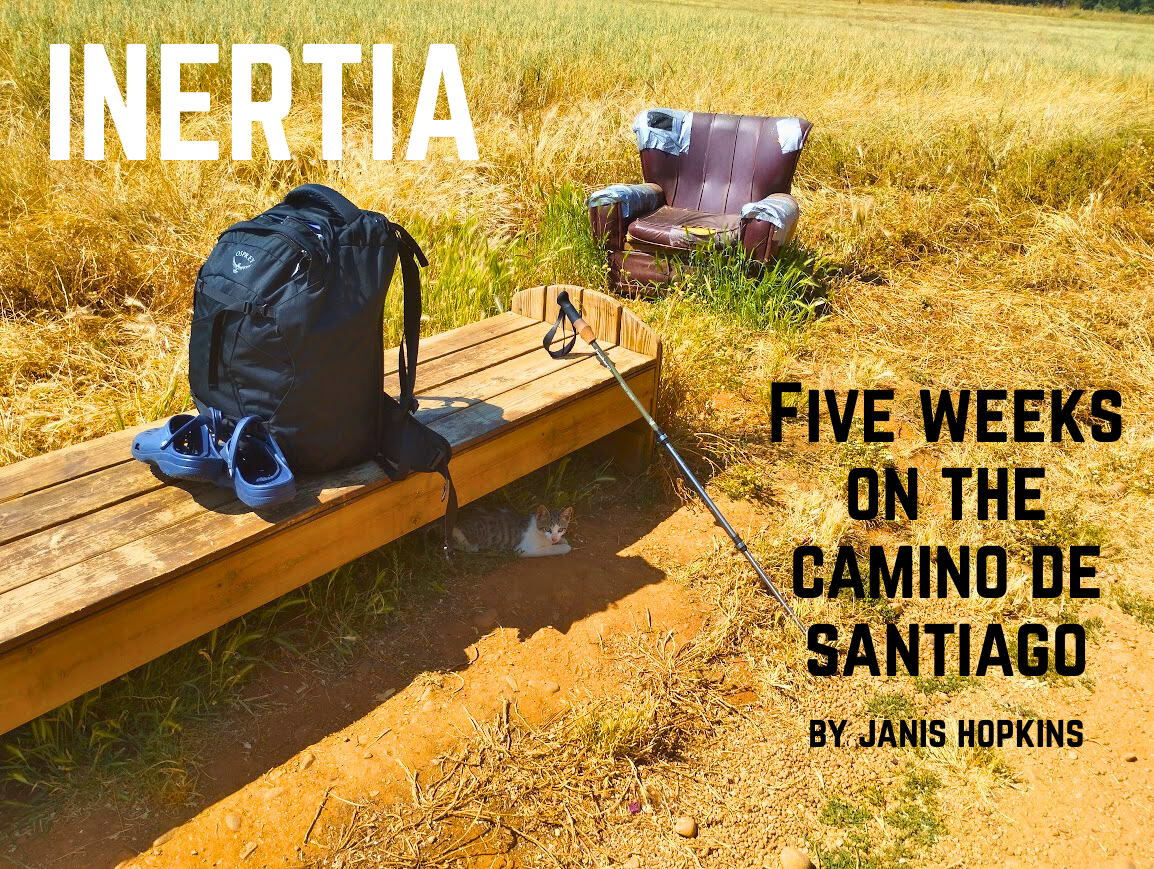
Somewhere between El Burgo Ranero and León I find a stone bench, I set my bag down, and I wonder if I am going to be able to stand up again.
Many routes of the Camino de Santiago, the ancient and latterly repopularised pilgrimage across Spain, are beautiful. They traverse mountain passes, wooded valleys, endless flat plains filled with poppies, thistles and birdsong. These are the memories that you cherish. But there are also stretches which seem to pass endlessly along highways, strange shuttered ghost towns, half-built infrastructure. In some places prefabricated bridges have been placed above what looks like a dry river bed but is in fact a half-built new road, dug out of the earth and still waiting to be filled with hot tarmac. Either side there are pale concrete drainage gullies, though there has been nothing to drain here for some time. There is something upsetting about a bridge to nowhere. A liminal space without start or destination. It doesn’t sit right.
Spain has a habit of beginning these grand infrastructure projects using a fixed allocation of EU money. When the money runs out, so too does the construction, as local governments are unwilling or unable to supplement it with their own. It is common to see large signs indicating that 30,000 Euros have been put towards renovating this town hall by the European Union: the town hall is half-renovated, and the scaffolding has become a permanent fixture, a looming skeleton which fades into the background, absorbed into the prevailing atmosphere of disuse and dereliction. In one town in the north of Spain, you can see the point where the highway stopped a hundred metres from joining the intended road, a mocking reminder of how close you came to a short-cut as you embark on a long, winding detour to get to a place you could walk in the time it takes to whistle a song.
Sometimes there are mountains and sometimes there is decay.
II
During the day in the punishing heat of June every shutter in every village is closed. If you don’t see another pilgrim, you may not see anyone. These are ghost towns, but who is haunting whom?
There is a certain finality to a shutter. Behind a curtain at night you may still see warm light seeping out through the cracks. A shutter renders the whole building flat. Many more modern Spanish buildings now have shop-style metal shutters rather than wooden ones, so there isn’t even the homely European aesthetic of wooden slats and flower boxes. They look like a high street bookmakers which has shut down for the evening. Sometimes the only things which move on those hot, windless days are the storks who roost high on the church tower. Every so often they unleash a machine-gun ratatat of clattering beaks and look down at you, unimpressed. They build their massive nests on the highest point they can find. In most places on the route, that is a church, and so almost every one carries its own delegation of holy birds, peering down on the passage of the faithful. Other times they occupy the pylons which stride alongside the roads, buzzing in the heat.
The days are so hot that for those on the road the world becomes bidirectional. There are only two planes. There is the dirt, which is baked yellow and slowly climbs up your legs, settling onto your sweaty skin, and there is the sun, the endless pressing anvil of heat, filling the air and pushing it out of your lungs. We become like Giles Corey; more weight. Many get into the habit of leaving before dawn, to try and break the back of the walk before the sky sets alight once more. I look down at my arm and see it stippled with droplets of white, where my perspiration has pushed all of the cheap suntan lotion back out. The roadsides are fringed with bright yellow explosions of Spanish Gorse. The air smells a little like chamomile tea and a little like coconuts, and a lot like hot dust, hot flowers, hot skin.
I have by this point walked about 20km. I am barely over halfway to León. On the other side of the stone bench there is some graffiti. In a black marker pen, someone has simply written the word “HELP”.
Santiago de Compostela is over 300km away.
III
The Camino de Santiago is having a moment. In 2024 just under 500,000 pilgrims made the trip to the cathedral in Santiago de Compostela in Galicia, northern Spain. 25 years ago that number was about a tenth of the size, with 55,000 recorded in 2000. The number continues to rise. There has even been the most ominous of all cultural validations: a celebrity travel documentary, in which Ed Byrne and professional celebrity reverend (why are there so many of these?) Kate Bottley, among others, walked it and declared it difficult but rewarding.
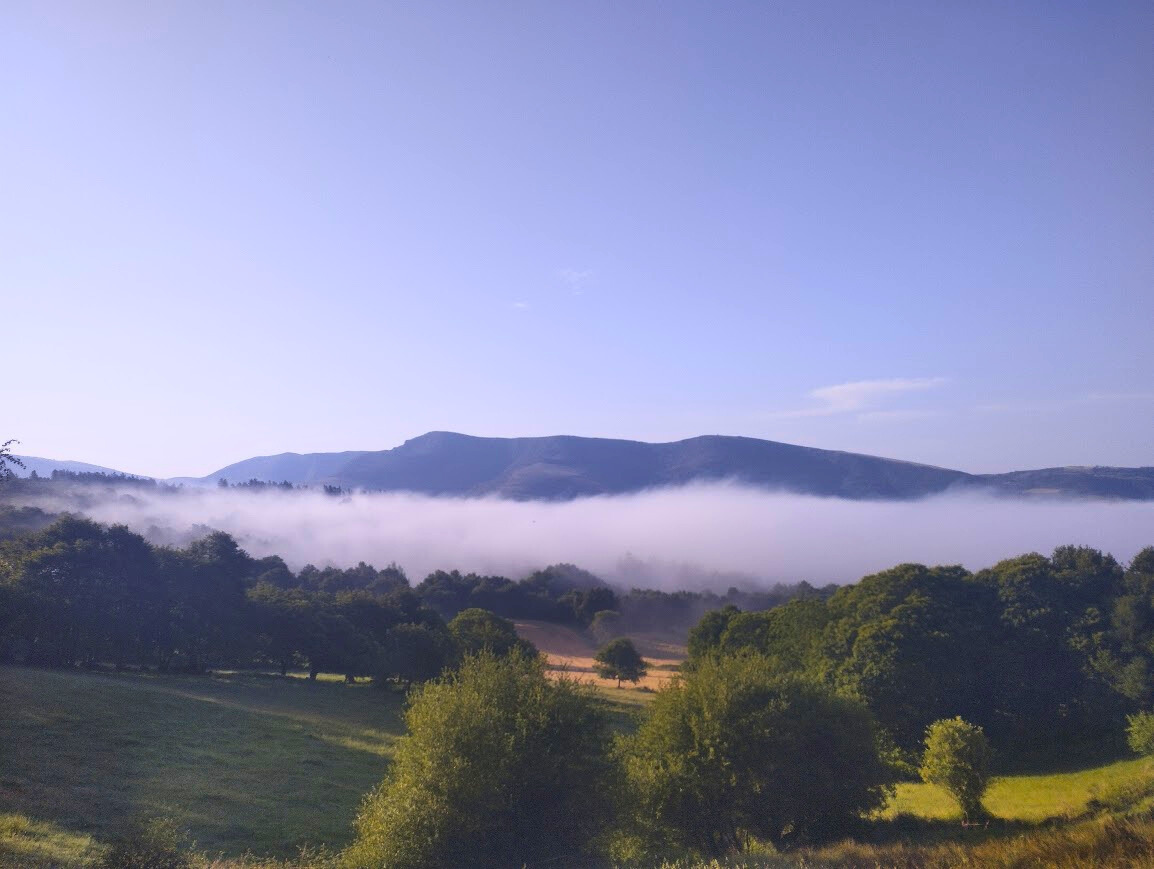
There are several routes available. The spectacular Camino del Norte runs across the very northernmost edge of the country, passing through San Sebastián, Bilbao, Santander and Oviedo, taking in the fiercely proud, separatist Basque region as well as Cantabria, Asturias and Galicia. This is España Verde: shielded by the Cantabrian Mountains from the baking heat of central Spain, it is lush and mountainous. They drink cider grown in the valleys and eat some of the best seafood on the planet. There is an even more precipitous subroute which diverts at Oviedo called the Camino Primitivo, the oldest route of all, believed to have been taken by the first peregrino, Alfonso II of Asturias. This travels through the Picos de Europa, and is not gentle on the knees.
By far the most popular route, however, is the Camino Francés; the French Route, which begins just over the border in St-Jean-Pied-de-Port and crosses the Pyrenees on the very first day. Only 14% of all pilgrims on the Francés complete the whole journey from St-Jean-Pied-de-Port to Santiago de Compostela, with the majority joining for the final 100km or so in Sarria; this is sufficient to receive the Compostela or certificate of completion from the Pilgrim Office. The Francés has few of the grand depths and heights of the Norte or the Primitivo - in many respects this is the reason for its popularity. It has sections so long and flat that you might lose your mind at the sameness. The meseta, the great plain which you cross somewhere between Burgos and León, has little shade and little mercy, but is more hospitable for those of diminished fitness levels. Many pilgrims you meet are retired or semi-retired.
The other thing distinguishing the Francés is that it is, for much of the walk, a purely pilgrim experience. The Norte passes through thickly touristed areas, and pilgrims will find themselves competing with travellers staying in commercial hostels in major cities along the coast. The Francés moves through areas that most short break tourists[1] don’t bother with[2]. There are some towns, such as the stunning O Cebreiro, perched on top of a hill overlooking two steep valleys, which are essentially uninhabited when not filled with pilgrims. This ebb and flow likely goes some way to accounting for the depression of some of these smaller towns, as they become like seaside resorts in winter: the money dries up, the albergues[3] close, the shutters go down. This is a pilgrim economy.
There are inevitable complaints about commercialisation, about how the Camino ain’t what it used to be, about how the influx of new pilgrims are ruining the experience for everyone else. I have no knowledge of what the Camino was like before, but judging from the carping you’d expect to run into an influencer in every other town. This was not my experience.
Pilgrims are in many respects the same people that they will have been a hundred years ago. People who reached a crossroads in their life, or suffered a tragedy, or an unexpected freedom (or sometimes both). I meet an American woman who began the Camino after her husband passed away - an unfulfilled goal she had been holding onto since she was in her twenties. The post-divorce Camino appears to be a common reason too, often women in their late middle age who feel that they have life to catch up on.
Often it is the younger people who are walking for overtly spiritual reasons. Sometimes they are Catholics[4], but the spirituality can be more diffuse. They speak of centring, of being present, of escape; the language of self-help and 2020s mental health advocacy. It’s easy to roll your eyes at this. Screen life is so all-consuming and totalising that nobody really takes seriously the idea of unplugging, though everyone aspires to a kind of digital flexitarianism. No meat on Mondays, try not to use my phone for 3 hours before bed. It is this aspect which most focus on when discussing the Camino’s boom period - is it the crushing weight of modernity which is driving our young people onto the road?
The digital detox isn’t as easy as it sounds. Albergues are booked the day or the afternoon before if you don’t want to arrive and start your Mary-and-Joseph-in-Bethlehem routine (some are very blasé about this but the majority of people don’t want to run the slim risk of having to sleep under a tree - it happens!). Google Maps can be needed to find the route if you lose it, usually in cities - the route outside of them is hard to miss, marked as it is every few metres by a big yellow sign and probably another pilgrim. And nobody wants to break their leg halfway up a mountain and try to signal help using a whistle thanks to their digital detox.
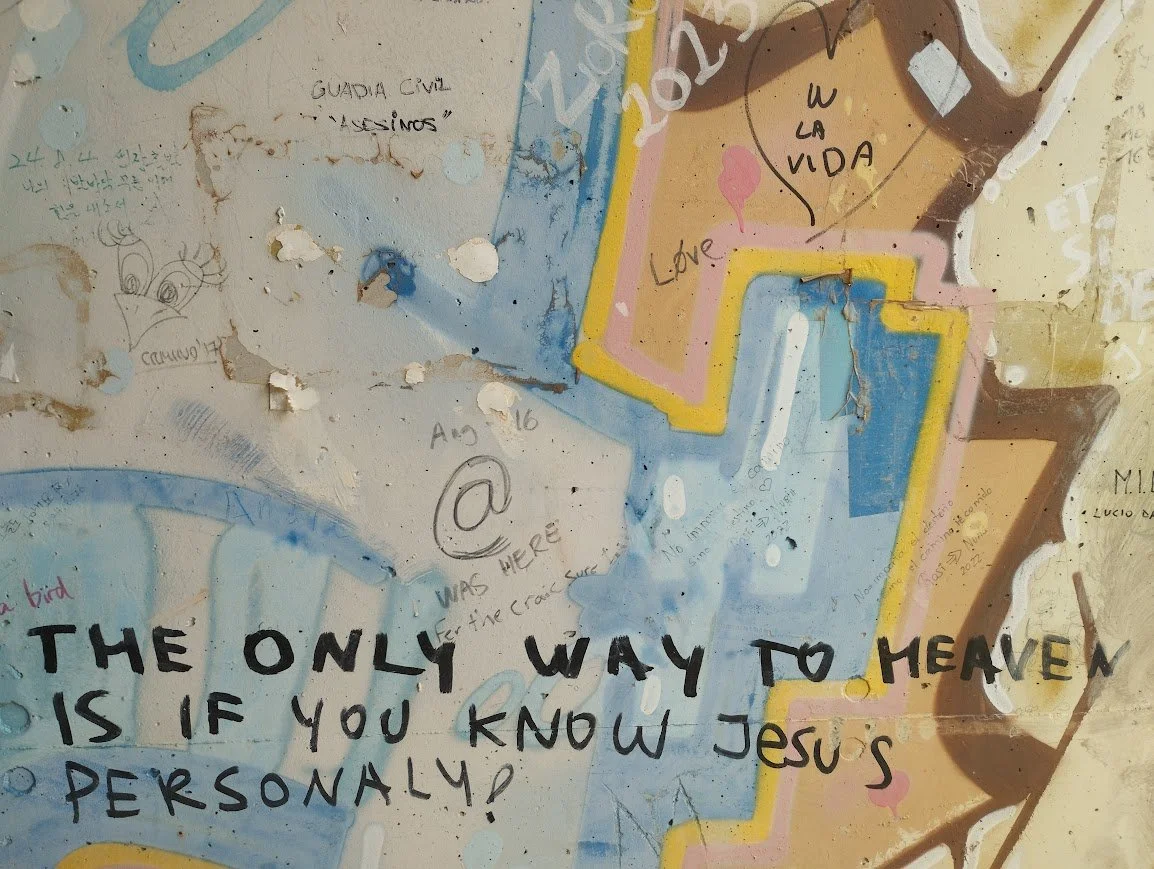
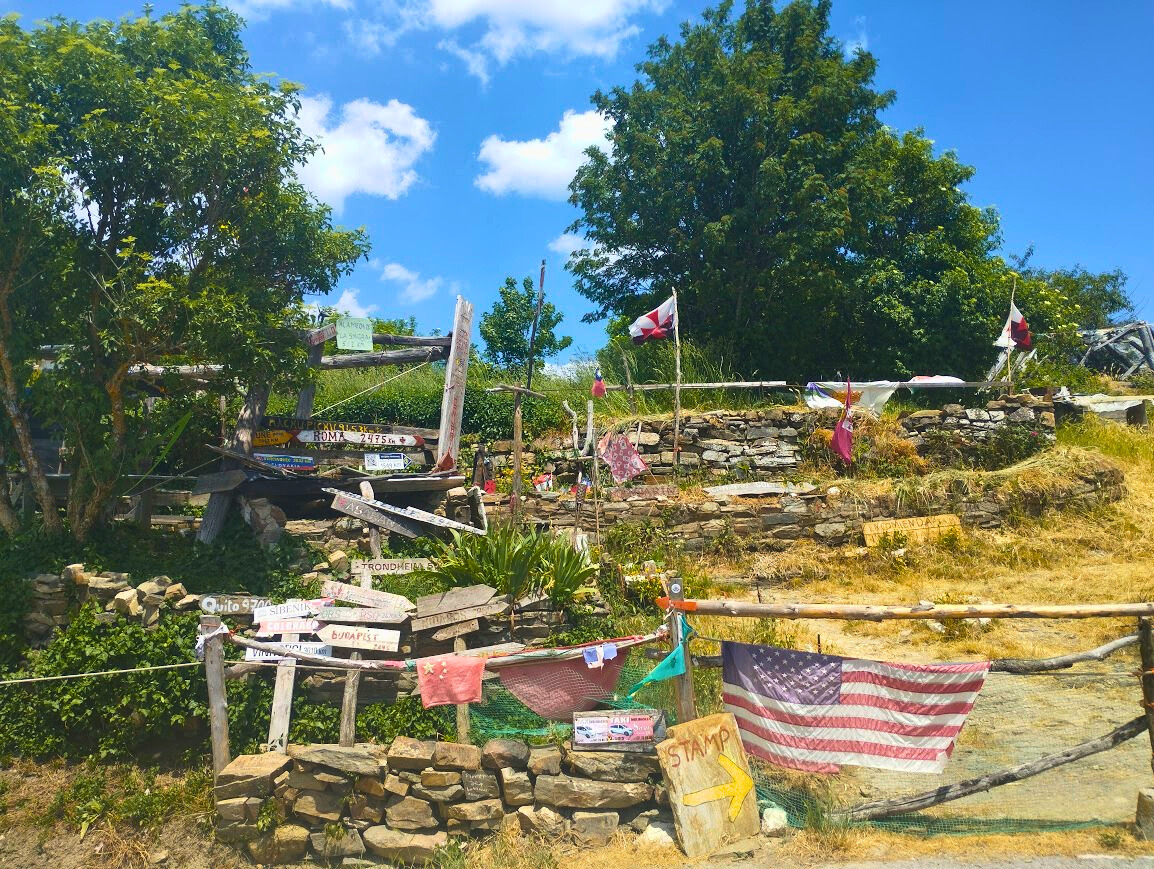
What modernity has brought to the Camino is a new set of things being left behind. The route is thick with stickers and graffiti. In places there are huge shrines, formed not from rock but from one person leaving a token tangling from a tree, and then a second, an organic series of decisions which unfold until you turn a corner and find a random patch of Spain alive with ribbons, scarves, painted rocks, carved wood and photographs dangling from pieces of string. Most of the time this is the kind of harmless communal activity which has taken place along these routes for centuries. Once the pilgrims made little stone cairns; now they leave a laminated emblem from their local church.
You do come across the occasional slightly more aggravating, self-promoting variety. On my walk there was an inescapable sticker advertising a “Camino Song”, available on all streaming platforms. I resolved to never, ever listen to it. There was also the occasional piece of graffiti left behind by someone clearly experiencing some sort of severe mental disruption, such at the one just outside of Villavante offering “nice daddy gives his gametes free to infertil[sic] people/couples/women”, along with a helpful illustration of someone firing sperm towards a sad couple. Be reassured, however: he only needs “5 minutes max”.
IV
Every few minutes there is a waymarker indicating that I am still on track, erected by the Castilla y León regional government. In very Spanish fashion, every sign has the Castilla angrily scrubbed out - this is because you have passed the invisible line after which the locals now consider themselves exclusively, furiously Leónese. The inverse was true a little further back, as the historic Castillians marked their resentment towards the monied, up-their-arse residents of León. We play at inter-regional rivalry in the UK, but truly we are nothing but amateurs. The Spanish nurture local grievances like houseplants.
After a few minutes I leave the bench, I swing my bag over my shoulders, I slide my hand through the loop on my hiking pole, and I keep walking.
The days are punctuated with abrupt changes in mentality. It’s so over, we’re so back. There are times when I think that I’d happily sleep in a bush rather than keep walking. And then, an hour later down the line, I am filled with a kind of euphoria, a walker’s madness, and I speed up again. I am a walking machine, eating up the miles, falling into an easy rhythm, one step after the other.
On one memorable day, between the ancient Roman town of Astorga and the Templar city of Ponferrada, I am seized by such grandiosity that I abandon my plans to stop, and walk an extra 13km across a mountain in the thunderous heat of the afternoon. I am entirely alone. There is no wind, there are no cars, there are no pilgrims. Occasionally a colossal bee wends a lazy path past me to settle on a low heather bush or another omnipresent Spanish Gorse, the scent of which is so strong in the air that I feel like sneezing. I sleep badly, and the next day is deliriously unpleasant; grey and muggy, the sky oppressive in a whole new way, swarms of flies landing on my sticky skin every time I make the mistake of standing still for more than a second, slithering down rocky scree the other side of the mountain, and I am ready once again to lay down and die, let my bones bleach alongside the scaffolding and my bag become a piece of forever-litter alongside the highway, home to rats and slugs.
How might my life be different if I was able to tap into this Terminator-like self possession on demand? When I was much younger I wanted to join the army. Not because I had any desire to shoot anyone, but because the idea of being forced to do something appealed to me. Perhaps my problems with motivation might vanish if someone called me a worm or a worthless piece of shit, bellowed in my face, forced me to run 50km in new boots until my feet were turned to pulp.[5]
It’s all a question of focus.
Here is an unfortunate lesson to learn: people who use LinkedIn are right. Suffering is, to a certain extent, in your head. And though you cannot disperse the burning nerve endings or the twisted muscle which flares red up your spinal column, you can still trick your brain into forgetting about it. Do not count your steps. Do not think about your back, or your feet. Think about anything else in the world. Allow yourself to slip into the kind of baggy daydream that can accommodate hours.
People are jumpy around this fact. They worry that the implication is that those who are unable to overcome their own suffering are deficient or inadequate. Many suffer from chronic pain which penetrates even the haziest of daydreams. But they too would be able to explain their own cognitive methods of pain-management, of which distraction is one piece in the toolkit. This is not pain denialism, just a reflection on consciousness - we are enduring a physical and biochemical response but we are also having an individual experience, of which the physical response is just one component. There are moments where we are worse-equipped to deal with pain, and there are moments when we are better-equipped. There are also moments where, through the exercise of distraction or meditation, we can forget the pain is there at all.
This doesn’t mean that being unable to do this is a failure. But it is true.
V
Here is a typical day on the Camino.
You wake at the moment collectively decided by the shared brain of the dormitory. If you are lucky this is your first awakening. More likely you’ve already been woken in the small hours by your bunk mate going for their eighth piss of the night, or by a couple who decided they want to have a plastic bag rustling contest, or one of several megawatt snorers drilling holes in the ceiling. Once it passes 6am there’s a good chance someone will consider it fair game to simply put the main light on. Abandon any slender hopes you were holding onto of maintaining a solid 8 hours. This is Camino time.
Haul yourself out of bed, crumple up the disposable sheets which are stretched awkwardly over plastic, hospital-grade, wipe-clean mattresses, fumble for the stiff, hand-washed clothes you dried over the end of the bed the day before. Brush your teeth beside one of several undressed elderly men who look like beaten leather and consider sleepwear to be a foppish affectation. Try and have a shit, if you can manage it. The proximity of toilets is a constant weight on the mind. Choose your boots from the rack by the door, strap your rucksack across your chest and your waist, stare out into the soft Spanish dawn.
The first couple of hours pass in a fugue state. Muscles slowly unclench, aches recede, and you fall into a rhythm. The dawns are peaceful. Often the only sound is the crunch of your boots against the track. In some places the track passes through fields which are encircled by irrigation channels, and these are full of frogs and birds, singing and belching a dawn chorus that stills as you approach, so that you seem to be moving along in a patch of personal silence, extending a few metres either side of you.
If you have planned intelligently, there will be a roadside café, a church, a food van or a bodega to make your first stop. It will likely already be swarmed by pilgrims, the roadside littered with rucksacks, hiking poles, people sitting on white plastic chairs or on the road itself, hauling back a pain au chocolate (a napolitana), a spanish omelette, tosta con tomate, a cup of strong coffee. If you have been walking for a while you may see a friendly face. You will compare blisters and ask where they are planning to stop. You will ask if they slept well, and they will say, “no”.
This is a nice café isn’t it. Don’t forget to get your pilgrim credential stamped. Are you ready for your shit yet?
By 9 or 10am, it will be hot. The brief period of blessed cool is over. The first beads of sweat begin to creep down your spine. Take off your jumper and put on your sunglasses. Is your back hurting again? You’ve only been walking for two hours, but after a brief period of loosening it seems like your body is already flying the white flag. You think, for the thousandth time, how am I supposed to do this? And then you will get up and you will keep walking, like you have every day so far, and like you will tomorrow too.
The day distends. Every person you pass, you say, “Buen Camino!”. Or perhaps mumble. It becomes like a mantra. Your lips form it without conscious thought taking place. You fall into the rhythm of the road. You take sips from your water bottle, you walk on the shady side of the road, and you slowly, diligently, perhaps even mindlessly, claw away another chunk of the distance remaining. Don’t think about how far it is. Try not to look at the distance markers. There is nothing more disheartening than feeling that you have been walking for hours and have only managed another kilometre. Some days you blink at the number and wonder if you have been travelling backwards somehow, lost in a dusty dreamscape, blinded by the fields and the road and the sun.
And then, creeping up on you on your blindside, moments of striking beauty. A tiny, tumbledown church in the middle of nowhere, handing out cups of sweet cordial, doors thrown open for weary feet, cool inside with weathered stonework and high, vaulted ceilings. A shaded path which emerges back out into the open to find that you’ve been transported to the top of a high ridge, a whole valley arranged beneath you. A stray kitten which trots mewling towards you as you arrive into a village. A field of red poppies so bright that it feels painted.
Fall into pace with a stranger. Ask them about their favourite town. Ask them how far they are going. Ask them where they are from. Ask them what it’s like working on a cruise ship, or in a covers band, or as a priest. Ask them where they’re staying tonight. Tell them that you’ll see them there. Buen Camino.
If you start walking at 6am and maintain a solid pace, you’ll probably arrive at your destination at around lunchtime. Most albergues open their doors between 12 and 2pm. If you’re very early, you can leave your bag to queue on your behalf outside of the front door. Check in, get your pilgrim credential stamped, make those final steps to your bunk. Set down your bag. Have a shower. Have a nap. These afternoon hours are something of a dead zone. Many use them to catch up on sleep. Others prefer to explore the town or village they find themselves in. Cold beers seem to manifest on the table without conscious thought being required. Bocadillos too, more omelettes, other food that falls somewhere on the bread-egg-ham-cheese axis.
You see the person you met on the road. They join you at your rickety table. You decide to cook together in the albergue kitchen. They tell you that they just recovered from cancer. They tell you that they lost their job. They tell you that they are about to get married. You talk about the fact that every national stereotype is completely true. You talk about the people you met, because you have both met the same people. You remember the Slovenian. You remember the man walking in flip-flops. You remember the nun riding the scooter in Carrion de los Condes. You remember everything.
As evening draws in, many will attend the pilgrim mass. In some places you may have your feet washed. Cards are handed out with multilingual prayer translations. Nuns with iron backbones stand to sing for long after you need to sit back down.
Later, the sun sets, but you’re well asleep by then. Earplugs in, eyemask on. You have the bedtime of a toddler now. Accept it. Embrace it. Collapse into your own private universe, and try and snatch as much sleep as you can. Tomorrow you’re going to do it all again.
VI
It has taken me half a year to write this piece. I was waiting for my revelation. Though not everybody will be quick to admit it, we hope to emerge changed from the Camino. Life is rarely so neat. I began to wonder whether my failure to feel a new person was a sign that I had done it wrong. Should I have listened to audiobooks and music, or did that distract me from my revelation? Was it hiding in one of the strangers I was too tired to talk to? Was my revelation forced into retreat by the glare of my phone screen?
Or, most damning of all, was my obsessive need to catalogue the whole thing in writing actually preventing me from experiencing anything? The problem with writing is that once you capture an experience in words, those words become the experience. Your memories are corralled and shaped and narrativised. Messy moments become comprehensible. And, when I think about it now, I don’t picture the place, rich and sensory and brimming with my own emotions, fears, aches and joys, so much as my description of it, selected because it seemed to represent some aspect of the day I decided was important. And it is hard for a revelation to take root in such thin soil.
The truth, as anyone wise will tell you, is that revelations don’t really exist. Or that inasmuch as they do, they are like the parable of the boiling frogs. The temperature of the water rises so slowly that one day you realise you’re warm and you don’t ever remember anything changing[6]. Life is lived forwards and understood backwards.
Stop counting the steps, stop checking the time, stop looking at the mile markers, and trust that one day soon you’ll be in Santiago.
[1] Is a pilgrim a tourist? This is a somewhat fraught question, especially with the prevailing atmosphere of hostility towards tourists in Spain. There have been anti-tourist protests in several major cities. It’s a distinction I’ll make here but let’s consider it a slightly hazy one: certainly the places pilgrims pass through are not usually visited by daytrippers. And why would they be? They’re full of pilgrims, patching up their blisters, farting through the night, blocking out every free bed for several miles in a row.
[2] Though they should: Burgos, León and Astorga are all stunning medieval cities that rarely make it on a weekend break itinerary if you aren’t Spanish.
[3] The largely pilgrim-only hostels, many of which are run municipally or by a local church.
[4] A girl explains about a revelation that came to her while she wept and prayed: that if Christ could forgive the sins of humanity, she could forgive herself. This was the lifting of a great burden for her. She doesn’t say what she did wrong and I don’t ask.
[5] I don’t think it would work. If anyone raises their voice at me my instant, overpowering reaction is to say, fuck off, fuck you, I don’t want to play any more. This is why I never succeeded in football. I tried playing 5-a-side while at university and a very loud goalkeeper spent the whole time bellowing at me and telling me where to stand. He may have been, strictly speaking, correct, especially since I was playing on no sleep and a combination of ketamine and Pro Plus, but I was far too brittle to appreciate it.
[6] Here we must imagine that the frogs, rather than being boiled, are being slowly brought up to temperature in a nice warm bath.