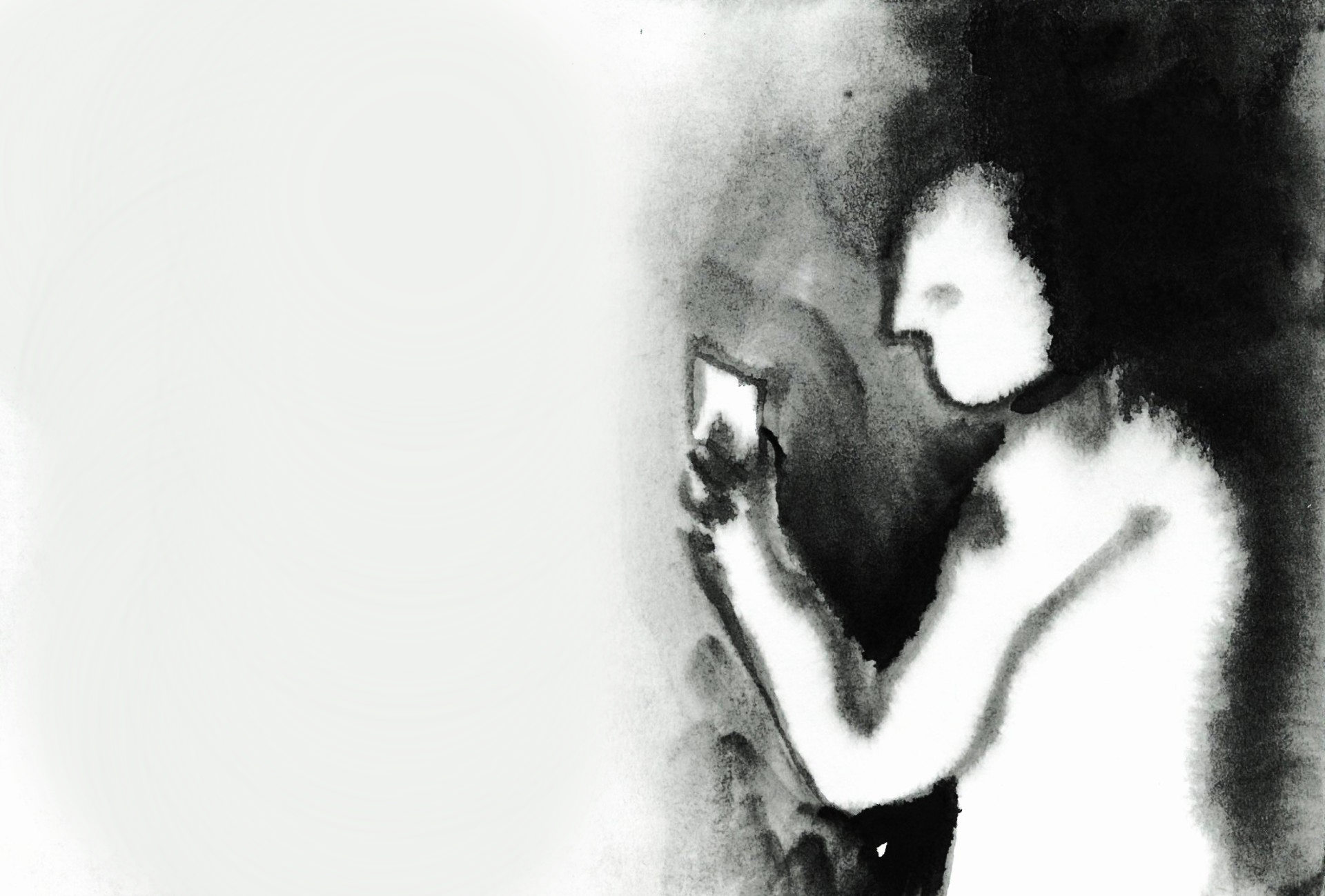
Art by Dulcie Power
Back in university we’d often entertain ourselves with videos of car crashes. They were posted to YouTube in compilation format, the more violent of which would often include a big, obviously bullshit, disclaimer: NO ONE WAS HURT. This was perfect predrinks entertainment. You’d ooh and ahh and wince and laugh, cracking open another bottle of Buckfast while you watch someone have the worst day of their life. It was perfect because it was non-narrative, so you could leave the room without feeling you’d missed something, and it was perfect because a car crash montage is content that demands a reaction. You will all feel something as you watch it, and you will all express that feeling, and then the ice is broken. Ideal for a new group, ideal for an old group, ideal for any situation. I’d never given much thought to it, normal as it was for us. But it was a small part of something that goes deeper.
Fast forwarding six years, I was recently in the too-bright bathroom of a buddy’s house. It was poker night. Beers, new friends, low stakes gambling. The buy-in was fourteen dollars. After winning a particularly risky hand, I’d excused myself to the washroom to celebrate with a Royal Flush of my own. Upon sitting down, I automatically produced my phone from my pocket, opening Twitter and reloading the page, revealing this trending tweet:
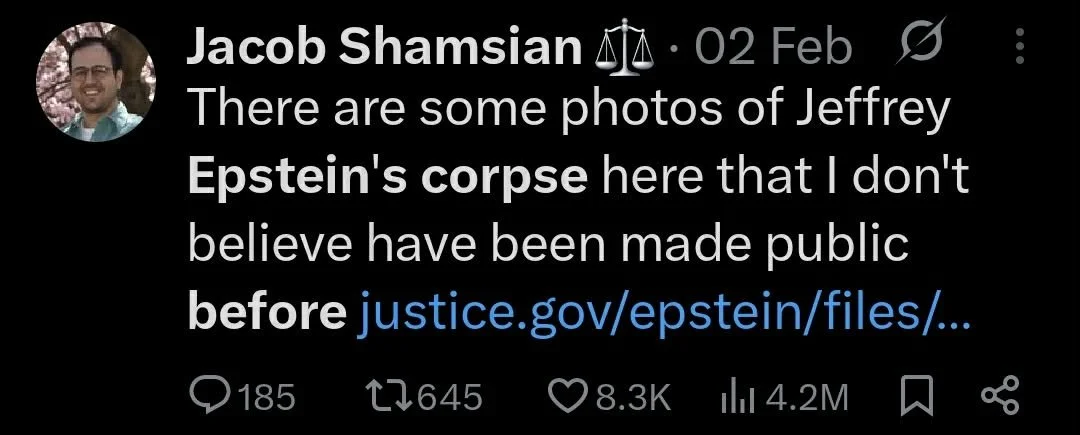
My fingers reacted without any intervention from my brain, and within seconds I was looking at photos of an old dead man on a gurney. There had been no intention behind the action, no pre-meditation in the car on the way over about how badly I wanted to look at photos of a dead paedophile that night. I was simply extended an opportunity by the infinite open hands of the internet, and my nervous system had chosen to reach out and grab it.
As I washed my hands, I thought of Jason Bourne and a thousand other film characters, frantically washing the blood of a victim off of their hands in a sink not unlike this one. The guilt making their fingers shake. I noticed how fine I felt, in comparison to that. Now obviously, I didn’t kill Jeffery Epstein (thank you Mossad), but I had been looking at photos of a dead body moments before, and the photos hadn’t made me feel anything. I hadn’t gained anything from seeing them, thank god, but I also hadn’t lost anything either. For the rest of the night, I was completely undistracted by my brief interaction with death. The Reaper did not follow me as I cashed in my chips, my stomach didn’t churn as I finished my oven pizza, and I wasn’t hit by an undefinable bad mood as I recycled my empties. Was it the alcohol? Was it my conscious distrust of the legitimacy of the images? Or did my body automatically recognise that an Israeli intelligence asset doesn’t really qualify as a ‘person’? This was unclear.
A lot of people will be equal parts confused about why I would want to see those photos, as well as confused about why I think I should have a bad reaction to seeing a dead paedophile. He’s one of the baddies, I imagine you thinking, of course you don’t care about seeing him dead. He deserves it!
It’s a strong argument, I have to admit, but it doesn’t exactly track with the reality of my experiences. For example, roughly six months ago American right-wing political commentator Charlie Kirk suffered death via neck-piercing on a college campus, in full view of hundreds of people and dozens of cameras. Videos were quickly shared online of the assassination, and within ten minutes of it happening, I’d viewed one such video half a dozen times.
Now, I didn’t share many views with Charlie Kirk. In fact, about the only thing that him and I had in common is that both of our heads constituted a sniper’s dream. That being said, the video of his killing was objectively gruesome. I watched it on repeat with my hand over my face. Although my body instinctively wanted to protect itself from the gore, my fingers knew me well enough to know that I really did still want to watch, and so they parted over my eyes, allowing my gaze through. Wincing, I watched. The reality of high-calibre violence never before captured so clearly or with such ironic timing. Here was a guy who, by all criteria, was absolutely The Enemy, and here was a video of him finally gurgling down a hollow-point instead of screaming them at a teenager. I should have been cracking open a beer and ordering four steaks on Deliveroo. But I wasn’t. Instead, I felt a bit sick. I still felt that feeling in my stomach that you get when you hear about an old person falling over. Or when you see a photo of a car crash where the driver’s seat has ceased to exist. The fact that Kirk was a bad man was inconsequential, I still felt something, seeing him die so horribly. Something innately human. But I kept watching. Why did I keep watching?
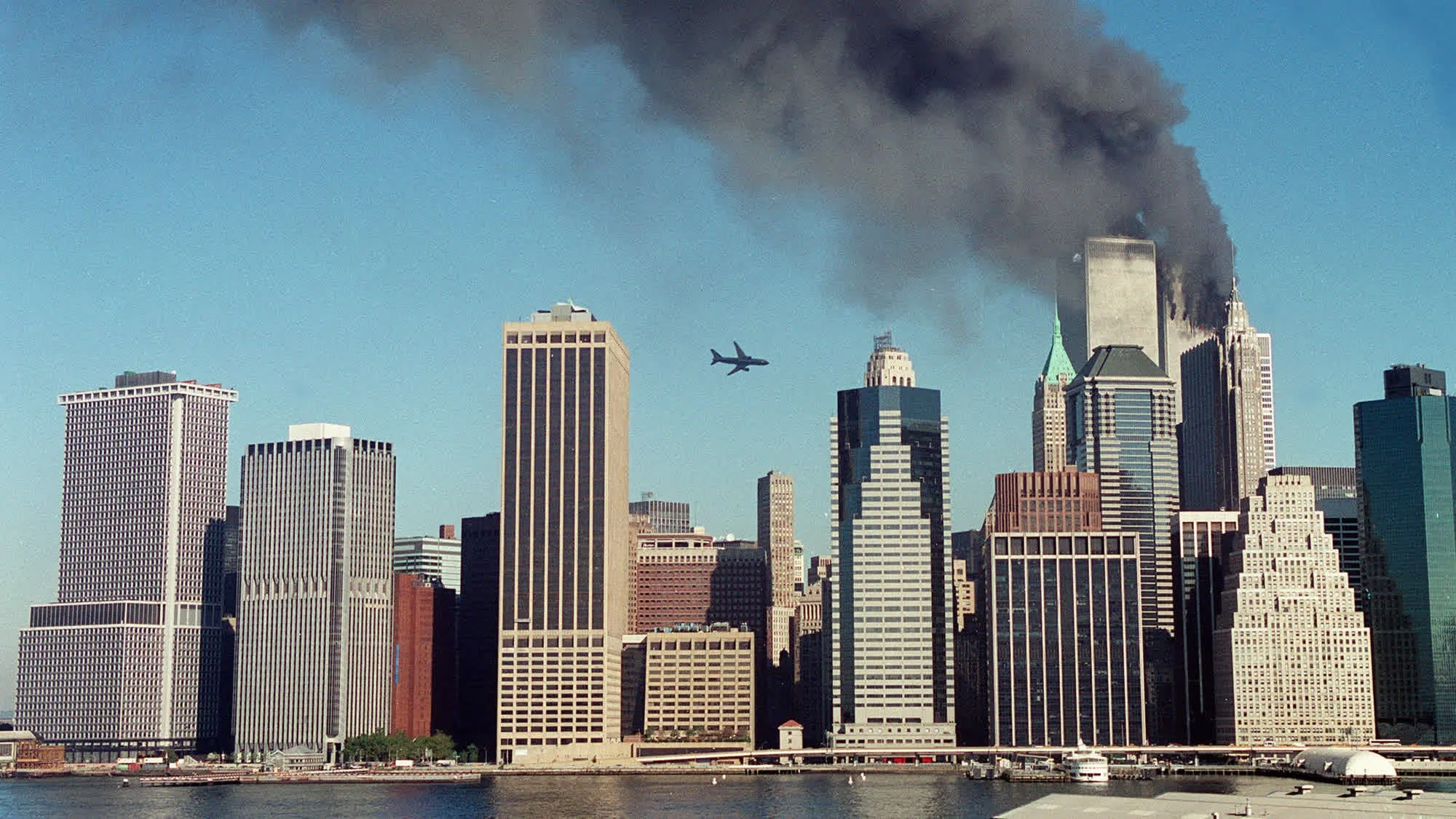
September 11, 2001
I don’t think it’s uncommon to be a little bit obsessed with 9/11. Many people, including several thousand US soldiers, have made a career out of it. The attack on the World Trade Centre in 2001 is one of the most significant events in human history, and the effects, which we are absolutely still feeling today, were inarguably intensified by the fact that it took place at a time when video of such an incident could quite easily be captured and disseminated in reasonably high definition to millions of people across the globe. My memory of the day itself is blurry, due to my age at the time, but the imagery of smoking towers and the second plane hitting are still something that I can immediately draw to mind without much effort at all. Speaking purely from a cinematic point of view, the footage of the day is spectacular. In fact, you can absolutely make the case that nothing more shocking has ever been put to video, before or since. When you put aside your own politics, it’s very easy to understand how those videos from 9/11 were able to mobilise the masses, launch an invasion, and permanently destabilise a region.
I remember being eighteen or nineteen years old, alone in my room, awake until the early hours of the morning, poring over video after video of debris and smoke and people falling from the sky and different angles of collisions and flames and collapsing buildings. All images that my brain simply couldn’t metabolise. My mind wasn’t designed to understand that scale of violence, but once again I couldn’t look away. At the risk of sounding insensitive, it had novelty. A brain that is very used to seeing cities intact will naturally be attracted to the image of cities destroyed. It’s a what-if response, an itch usually only semi-scratched by blockbuster action films, our greatest fears and hypotheticals realised in the most terrifying way.
What would happen if you flew a plane into a skyscraper? We know now. I know now. The videos have done their job. The itch has been scratched.
The hunt for novelty is something that reoccurs in my life. You might be surprised to know that, despite my bad attitude and aggressive nature, I’ve only ever really participated in one fight in my life, a drunken fracas outside a McDonalds in Nottingham that resulted in me being knocked out by a punch I didn’t see coming and didn’t invite in the first place. Suffice to say, I’m not a fighter. But every now and then it will be a Sunday afternoon, and perhaps I was drinking the night before, and perhaps I’ll be lay on my bed, Twitter open, and I’ll be served a Fight Video by the algorithm. It will be a brawl in a car park or outside a strip club. It will have originated somewhere in the belt of American states where the only three hobbies are smoking weed, filming black children playing near your property, and killing yourself while the family are out on the six-hour drive to Walmart. The caption will be something like:
This why you always gotta look both ways before you cross *skull emoji*
And the video will follow a guy who is so focused on killing or maiming the shirtless fat man in front of him who disrespected his favourite sports team, that he neglects to scan 360 degrees, thus failing to spot the wooden stool that is currently flying towards his head, borrowed from a nearby Denny’s.
I’ll watch one video like this, and if it’s “good” enough (measured via an internal metric that I find difficult to describe. Often the criteria is ‘funny’, sometimes ‘fucked up’), then I’ll send it to my group chat from home, a bunch of lads who will react with a “Jesus Christ” or a “hahahaha”. But then I might click on the profile of whoever posted it. @FightVids or something similar. And then I will lose an hour, easily. I’ll scroll through dozens of videos, cringing at the sound of the punches, laughing at the commentary of the cameramen, closing any videos where someone gets knocked out cold and they continue to film, because one of the few things that I truly can’t watch is someone having a seizure in that situation. But I keep going. And I never really understand why. I am, in my daily life, very good at avoiding conflict, especially violent conflict. So, I’m aware of the gap between what I expect of myself and the reality of what I’m ‘enjoying’ in my screentime. But I think that lack of conflict in my own life is what drives my hunger for consuming it in the virtual. What if it was me in that situation? What if it was me getting jumped at school by three girls after soccer practice? What if I was the one getting revenge on a bully who, on the surface, looks much tougher than me? What would these situations be like? I guess I don’t need to find out in real life now, because I can live vicariously through the people in my phone, from the safety of my bed in England.
The most upsetting what-if videos that I’ve ever seen are always the more benign ones. Less anger and intent, more accidents of happenstance and/or incompetence. Chinese factory workers pulled into a machine spinning at 30,000 rpm by a loose sleeve. A Moroccan motorcyclist crushed outside a coffee shop by a runaway tire, bouncing down the road off the back of an ill-secured truck. A Frenchman slipping on a wet roof whilst attempting parkour and becoming the newest part of the Champs Elysee. All these accidents are captured on grainy CCTV or high-def iPhone cameras, and all are uploaded to the internet by someone who recognised the spectacle and prioritised that above all else. These are the videos that scratch the itch I get when I’m at work on the ski hill, looking up at the bull-wheel of the chairlift above me, wondering what would happen if I put my hand into the mechanism. These videos are more troubling to me because they’re so much more achievable in my life. When I watch the fight videos, a conscious part of me knows that I would never be in almost any of those situations. But with the accidents, a conscious part of me knows that I absolutely could. And there begins a very real fear that one day I’ll end up being memorialised by anonymous posters on Twitter, or Reddit, people who go by names like mosttwistedjoker45, operating in spaces where violence and death are still fair game for daily entertainment.
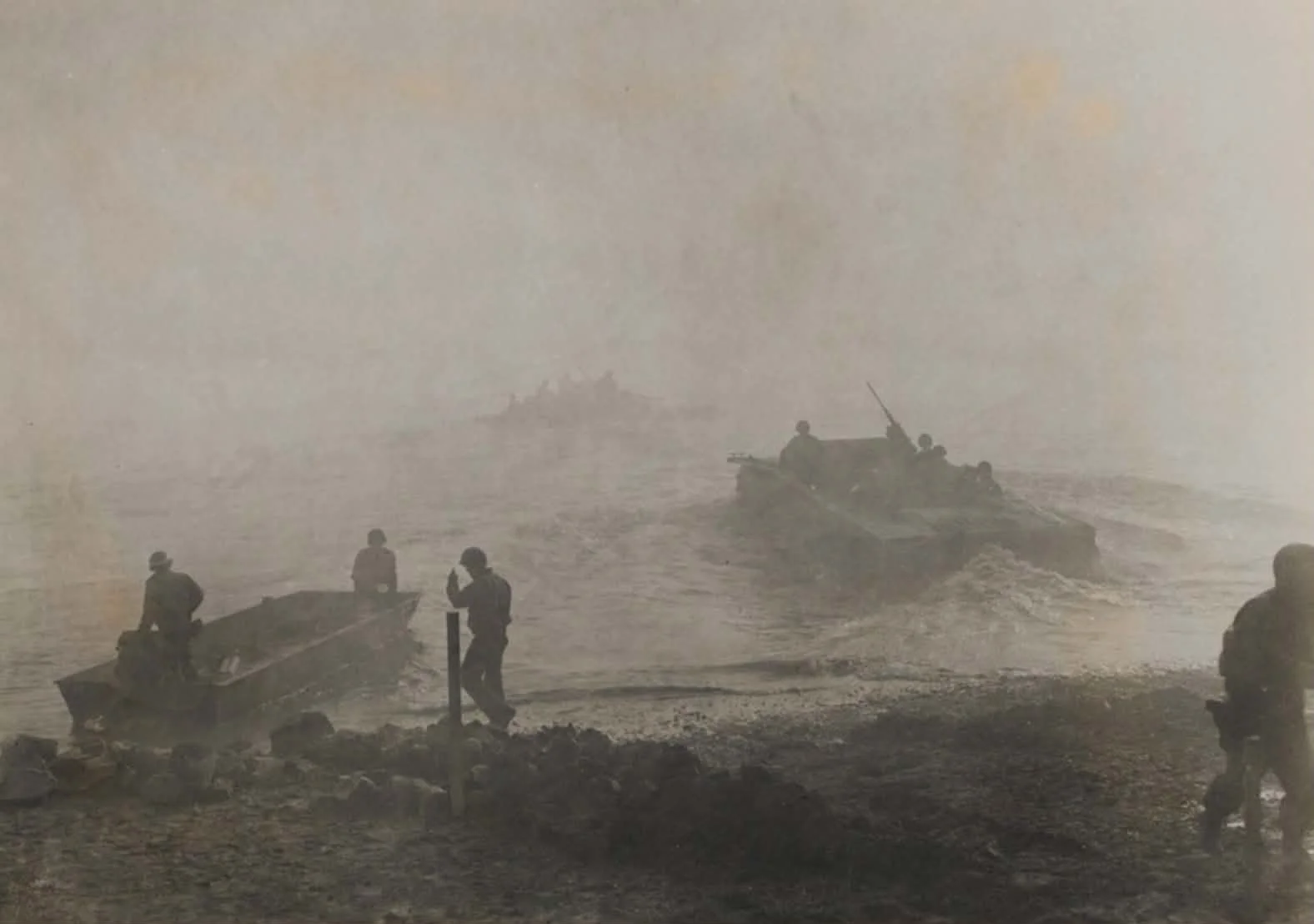
American soldiers in the Pacific - 1945
On Reddit, there’s a community called r/CombatFootage which has close to two million members, averaging five-hundred-thousand weekly visitors. The subreddit is dedicated, in the moderation team’s own words, to being ‘a forum for combat footage, and photos, from historical to ongoing wars.’ I originally became aware of it a few years ago, when I was first getting into film photography. A rabbit hole of research into well-regarded historical photography led me to war photography, with my interest piqued by photos from the Eastern front in WW2, and from there I found this community. Immediately, it was clear that this was something different, and something that I wasn’t really aware was allowed to exist. The war in Ukraine had only recently begun at this point, and the homepage for the subreddit was full of clips from the conflict. Helicopters firing missiles into residential buildings. Tanks crashing through city streets. Jets shot down over green fields.
As the war waged on, and the nature of the violence evolved, so did the videos. First the conflict in Ukraine reintroduced traditional trench warfare, now with the added egoistic element of helmet-cam GoPro footage, seemingly an accepted and encouraged element of the propaganda wing of both sides of the war. For the first time in history, you could see what it really looked like when a soldier tore through an enemy trench with an automatic weapon, the fighting up-close and brutal. If that wasn’t close quarters enough, a now infamous clip was shared of two opposing soldiers having a literal knife-fight, ending with the victor apologising to the man he’d killed in subtitled Russian. I watched it in 4K.
Drone attacks had been pretty common from very early in the war, but as the combat got stretched and the online element grew, certain darker aspects became more and more prevalent. Even outside of places like r/CombatFootage, it was now incredibly difficult to avoid seeing videos shared of Russian soldiers’ last moments on the battlefield, alone and afraid. The videos are all fairly similar: A drone buzzes around, twenty feet or so above the ground. The landscape is devastated, muddy and grey and peppered with the craters of previous explosions. In one such crater is a soldier, usually injured or otherwise defeated. Their weapon is often cast to the side. They see the drone and do one of a few things: pretend to be dead, ignore it entirely, or plead for their life, hands together in prayer, begging for mercy from the little plastic toy, their last words silenced by the lack of a drone mounted microphone. The operator of the drone always seems to take their time. They film the man for long enough that you can’t help but imagine the situation from their perspective, sat in the cold mud, almost certainly having accepted the fact that they’re about to die, almost certainly aware that the only reason they haven’t died yet is that their death will be posted on the internet within the next forty-eight hours, and almost certainly aware that, from a filmmaking point of view, making the audience wait those additional fifteen or thirty seconds will be key in building up anticipation, and almost certainly knowing that this anticipation will increase the odds of the video of their death going viral. The longer you watch a man who is about to die, the more likely it is that he will do something worth watching. The clip ends with a grenade dropped, or the drone flying directly into the man, camera feed cut by the resulting explosion. The man is now dead, the drone operator is now presumably celebrating, the video will receive millions of views, supporters of one side will briefly feel like they’re winning, the war will continue, more drones will be built, more men killed, etc. etc.
Ray-Ban recently partnered with Meta to release a line of sunglasses that have a high resolution camera built into the frame of the shades. The adverts for the glasses showcase all of the cool things you could use them for: livestreaming your DJ set directly from your eyes, photographing a friend taking a bite of pizza, making a Boomerang of you and the girls enjoying Galentines. What the adverts don’t show is the implicit and much more insidious uses of the technology: filming sexual encounters without consent, recording random women on the underground, livestreaming your school shooting. These are all things that the developers are aware of, and to some degree I’m certain that they’re relying on the sicko demographic to boost sales. But like all things in the world of Silicon Valley, the question of whether something should be built is never asked. The question is always; will it sell? And yes, a device that allows you to record and upload every instance of public disorder that you see, will absolutely sell.
So now I’m thinking about those car crash compilations. And I’m thinking about the ingrained urge to witness the abnormal. And I’m thinking about the likely widespread proliferation of what is essentially spy-cam recording equipment. And now my new fear isn’t becoming a viral sensation in grainy CCTV footage of me falling into a manhole, and nor is my new fear that of being blown-up on camera by a drone sixty miles outside of Beijing. Now my new fear is being one of hundreds of normal people, captured in Ultra-HD as my heart finally gives out on the train between Sheffield and Langley Mill, part of a YouTube video titled:
MOST EMBARRASSING DEATHS ON EAST MIDLANDS RAILWAY – HUGE AURA LOSS
And when that does end up happening, I’d just like to say to those students who are watching at a predrinks twenty years from now: Enjoy it while you can, whatever comes next will be worse.